"Behold the Invisible
Thy will be done O Lord!
I See all, Know all, Tell all, Cure all.
You shall see the unknown wonders."
The narrator is given a handbill in the street on the way to Hambro's with this passage on it from Rev. B. P. Rinehart, spiritual technologist. I believe this was a foreshadowing of Invisible Man's realization that he is completely invisible to everyone around him. He will understand that he has had all of these identities forced on him by others, like The Brotherhood, or even the so-called big shots from the beginning of the novel when he says "social equality" instead of "social responsibility" and is asked to explain, to which he admits he made a mistake and the crowd is appeased. All of these events, and the fact that he was merely playing roles relinquished to him in these events, become clear to him.
On page 498, after the Invisible Man removes his disguise that causes some confusion for everyone between him and Rinehart, the Invisible Man comes to revelation: "It was true as I was true. His world was possibility and he knew it. He was years ahead of me and I was a fool. I must have been crazy and blind. The world in which we lived was without boundaries." This is a crucial moment for the narrator, where he realizes that he does have a self even though he is invisible to others. The veil that has been blinding him from himself is lifted at this point. He also realizes that Rinehart is a shape-shifting symbol for limitless possibility. The different aspects of Rinehart; Rinehart the Rounder, Rinehart the Rascal, Rinehart the Gambler, etc., that the Invisible Man is mistaken for lead to his understanding that he has never had a self because he has always accepted an identity given to him by others.
This was a poem written by Langston Hughes, published in 1951. Langston Hughes was a crucial part of the Harlem Renaissance as a social activist. The Harlem Renaissance had many goals and dreams, of which Hughes makes a point that if they are not realized, it can rot a people from the inside out. I believe it was Ellison's objective to make a point of preventing others from labeling members of the black community so as to crush their dreams. With Rinehart's character, he demonstrates that to be an individual, to know yourself, is the most powerful weapon one can have against a society's attempts at defining a people against their will.
The novel comes full circle on page 508 with this quote: "I didn't know what my grandfather had meant, but I was ready to test his advice. I'd overcome them with yeses, undermine them with grins, I'd agree them to death and destruction." The invisible man finally understands what his grandfather meant on his deathbed. In the previous paragraph he comes to the conclusion that, "I was my experiences and my experiences were me, and no blind men, no matter how powerful they became, even if they conquered the world, could take that..." The narrator, no longer the invisible man, at least not to himself, is filled with confidence now that he has defined himself, and he has a new plan, a new direction, and seems to be for the first time truly fearless.
Questions:
1. Is the yessing strategy recommended by his grandfather the best way to proceed? Why? Why not?
2. Who do you perceive Rinehart to be? Why had he been blind to Rinehart's existence before?
3. When does the game end with leading the double identity proposed by IM's grandfather?
Join up with a group (1, 2, or 3) and examine a chapter of the novel (Group 1 will examine Chapter 22 -- the Brotherhood's reaction to Tod Clifton's funeral; Group 2 will examine Chapter 23 -- Ras, Rinehart, and Hambro; and Group 3 will examine 24 -- yessing them to death -- Sybil and the escape towards Harlem).
In examining each section, create a list of AT LEAST 5 questions similar to prior lists posted on this blog and have one group member submit it in a comment along with a listing of all of your names. This will count a as a qualifying blog comment for all involved. It will also make it easier for you to get another qualifying comment by responding after class to the questions you developed.
Suggestions:
Chapter 22 (Group 1) -- consider why the Brotherhood members act the way that they do. Pay especial attention to their reactions to the IM's use of his "personal responsibility," why they resent Clifton being made a hero or martyr, and the significance of Brother Jack's eye.
Chapter 23 (Group 2) -- consider how Ras challenges the IM to speak for the Brotherhood, especially in light of the Brotherhood's reaction to the IM, why the IM initially chooses to disguise himself and what his disguise reveals to him. Also, who is Rinehart? Any questions involving Rinehart should be more specific than this one. What does Hambro tell the IM to do? What does he decide to do on his own and why?
Chapter 24 (Group 3) -- How does the IM go about his plan? Is he successful? What does Sybil want? How does the IM react?
Throughout the scene with IM and the woman, she implores him, whether with manipulative intentions or legitimate curiosity, to tell her about the Brotherhood.Her intentions aside, it is important to notice that outside his saying, “from now on one of our main concerns is to be the Woman Question,” (Ellison 414) he never truly responds with a satisfying response to her inquisition.His failure to address the questions asked of him is not without significance.The Brotherhood has offered IM structure, leadership, and an outlet for his compulsive urge to deliver speeches.However, his role within this system is not clearly defined and cannot be articulated much further.Realistically, IM is simply an abstract black figurehead of the Communist movement.This is illustrated by Brother Jack’s mistress who asks him, “But don’t you think he should be a little blacker?” (303). Her question suggests that while IM might possess superior skills as an orator, his skin color is the primary basis of his selection as the new leader.He is forced to give up his name and sever ties with his home and family while employed by the Brotherhood.In this way, IM relinquishes any sense of an identity he might have possessed and again enters into a struggle to reconcile his image in the North with his Southern past. While he sees the organization as a magnificent opportunity for his own advancement, he is blind to the fact that he is merely a pawn of the white leaders.Just as has been the case throughout the book, another outside force enters his life and squashes his identity.Although he is allured by the perceived leadership that accompanies his position, he is neither truly aware of the meaning of his role nor the ideological basis of what he is supporting.This same oblivion is what the vet admonishes him for earlier in the book when he tells IM to “Look beneath the surface” and “come out of the fog” (153).For this reason he is unable, or perhaps unwilling to attempt to articulate the details of his position within the Brotherhood movement when speaking with the inquisitive woman.
- Sam pointed out that this figure is a bank full of coins. Why does it upset the IM so much? Why does he break it -- turning it into a "broken image" (332)? Why does he take it? Why is everyone so suspicious of his attempt to get rid of it? 319-332
The First Brotherhood Speech
- What is the IM talking about? Why do the people respond so favorably? Why does the Brotherhood resent his speech?
Ras
- Another question raised in Tuesday's presentation: Is Ras crazy or wrong? (370-376) Is Clifton swayed by his arguments?
Mixed Agendas
How does the IM describe his time in the Brotherhood? Look particularly at his description of his success on 380-81.
The Mysterious Note
Who do you think wrote the note that the IM receives on 383? How does the message affect him?
Brother Tarp
- What role does Brother Tarp assume in the IM's life? Consider his gift of the picture of Douglass on 378 (also 381) as well as the chain link (386-90)
- What might be the significance of his appearance on 384? (Also see 389-90).
- Why is Wrestrum so upset by the link? (392-93) What does it lead him to say to the IM? What does it lead him to do?
The Woman Question
- How do the women react to the IM? See 409-10, 420 and chapter 19 in general.
- What does it mean to be a "salvationist"? Is the woman he goes home with really interested in learning more about the party's politics? (410-15), especially the definition on 410, her reflection on 412 that "Life is so terribly empty and disorganized" without an ideology to stick to, etc.
- Do you think the situation with the woman is a trap or test (as the IM fears)? 415-420.
- What's the deal with the woman's husband? Why doesn't he react to seeing her in bed with the IM? Does he really not see him? (417-18)
Tod Clifton's "disappearance" and/or funeral
- Do you think that Tod disappeared of his own will or do you think that the party discouraged or threatened him? See 421-22,
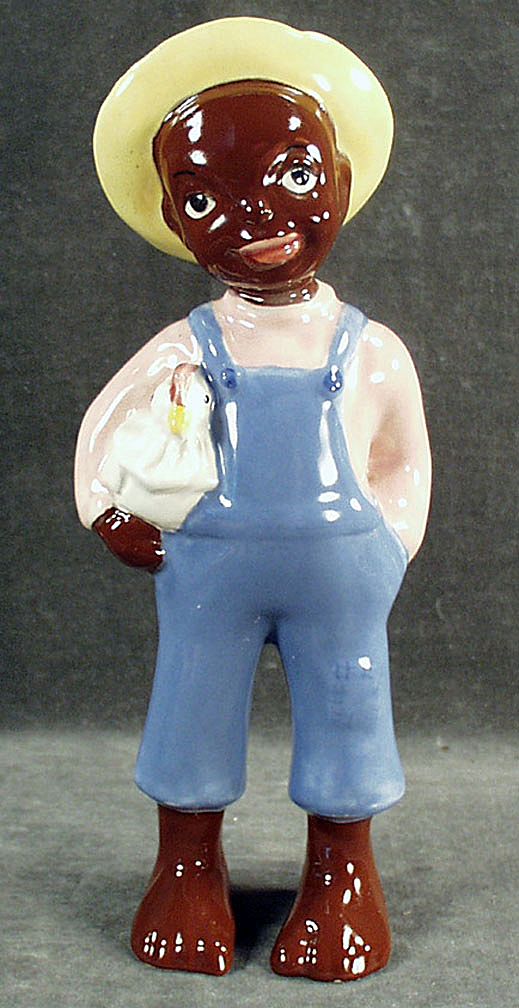
- Why is Tod selling those Sambo dolls? (431-35)
- What happens with the cop? (435-38)
- What is the significance of the doll's construction -- the way that it dances (446)?
- Why can't the IM sing like the old man with the knife welt on his throat? Why is he incapable of "arousing" the song? (452-3)
- What do you think of the IM's speech? What is he trying to say? Doeshe have anything to say?
What happens in Harlem when the IM is downtown with the women
- Why do the men at the bar get so threatening when the IM returns to Harlem? (423-27)
- Is the situation in Harlem a result of the IM leaving? Is it something else? Why was he sent out of the district?
The Invisible Man's experience in the subway
- What does the IM think about being outside of history? Is it desirable or undesirable to be outside? (439-44)
- By extension, what opportunities does the Brotherhood seem to offer African Americans? (439)
- Why does the IM follow the "boys...in their well-pressed, too-hot-for-summer suits" (440-442)?
- How does he begin to see Harlem in a new way? What does he realize about the area and about himself? (443-4)
According
to the OED, a “Salvationist” is a person “with capital initial. A member of the
Salvation Army”, and/or “one who rescues from peril; a savior”. This is a very heroic and noble definition,
which would place the woman into this army. Nevertheless, Brother Jack claimed
“salvationists” were “wealthy members who sought political salvation by
contributing financially to the brotherhood”(Ellison 410). Therefore, if they
have to buy their own safety, then they are neither a savior nor being saved.
They are just a consumer of self-interests using their “capital initial” to
avoid peril, not rescue someone or something from it. The woman who seduces the
IM is a “salvationist" in a sense that she will buy out anything she has
to buy to get her way, either using her sensuality or her money. This poses the
question: Is she trying to sexually buy out the IM to get some valuable
information and set him a trap, or is she just a capricious, lonely wife
seeking to satisfy her carnal needs? In a cultural and historical approach to
this particular scene, the article by Erika L. Doss “Images of American Women
in the 1930s: Reginald Marsh and "Paramount Picture"”, depicts the
different constructions of women, the woman glorified and enshrined in the
movie screen, enormously contrasted with the working class woman. For the
purpose of the book and the image of this particular woman, focus will be drawn
on the glamorous movie symbols. The woman who is seducing the IM is a portrait
of 1930’s Hollywood sex goddesses such as Jean Harlow and Mae West, known for
their unconventionally open sensuality, defying all social standards and rules and embodying the Woman Question.
They were portrayed as the ones who, “Tempted men with their beauty and
sexuality. Dressed in silks and satins, moving gracefully but provocatively,
whispering and chattering in low-keyed, coy dialogue…”(Doss 2). If the woman
who is seducing IM whose “train of her gown trails sensuously over the oriental
carpet” is an image of the glamorous, deviant women in the movies, then she has
no cruel intentions with the IM (Ellison 412). She exudes sexual desire all
along the scene, and it is evident in her dialogue and body language. At one point
in her seduction she says to the IM, “Brotherhood, darling,” she said, gripping
my biceps with her little hands. “Teach me, talk to me. Teach me the beautiful
ideology of Brotherhood”(Ellison 415). The dialogue aspect Doss refers to in
her article as one of the weapons women implemented in seduction are clearly
used by this white, upper class woman. The imagery offered is that of the woman
using a seductive voice, and irresistible body language. Conversely, Doss also
points out how this sexuality of glamour and rebellion was also presented as
“both cunning and destructive”(Doss 2). This sense of destruction is also
present in the scene. She is neither interested in learning more about the
party, nor is she part of a bigger conspiracy to test the IM’s character, but
she is destructive in an implicit way that she may or may not be aware of. She
has destroyed the consciousness of the IM. He will now indulge himself in
paranoia once again, looking over his shoulder, and painfully waiting for the
time he is punished for falling into temptation. She enounces the words IM
wants to hear, engaging in an eloquent version of “dirty talk”. She exclaims,
“I wish to embrace the whole of it. Life is so terribly empty and disorganized
without it. I sincerely believe that only Brotherhood offers any hope of making
life worth living again”(Ellison 412). Her words attribute her qualities of a
hypocrite considering the fact that she, personally, has no organization in her
life whatsoever. She is basically living in a fake, unstable marriage already
leading a life that she seems to be content with, having multiple, unattached
partners to fulfill her carnal desires. Her tone is that of a suspicious
reassurance. Using the word “sincerely”, it seems to be that she is overstating
a belief to cover up the fact that she doesn’t really think that way. She just
wants to allure the IM in. She is a woman that will genuinely talk and seduce
her way into getting what she wants, not what others want.
When a man finds his woman with a
lover in his own bed, the typical response is that of wrath and revenge that
can often lead to murder of the betraying parties. Nevertheless, in IM, the
reader experiences a particularly blank and indifferent reaction. As the
woman’s husband walks in on her and the IM, “his face is expressionless”(417). The
scene is carried out in a very natural way, and the husband seems to be completely
unaffected by the sight. He marches off and even says, “Night, and you
too”(Ellison 417). Here, he is addressing both his wife and the IM. This
surreal scene of pardon and unresponsiveness suggests that they are another broken
marriage staying together to pretend for the upper class public. They have gone
their separate, lustful ways, but live under the same roof to avoid the infamous:
What will they say? He sees the Invisible Man, he surely does. Any man would
see the man who is usurping his place in bed. The husband has become blind to
the sights, immune to the discomfort, accustomed to this sinful way of life,
and protective of his appearance in a rich and condemning social circle.
Questions
Is this woman the embodiment of the Woman Question, or is she just part of the answer?
What is your
personal stance on this? Do you think she is part of a larger conspiracy to
test the IM?
What do you
think is the function of this reverse response from the husband? What is
Ellison trying to get across with this?
These odd and
surreal behaviors, as the one mentioned in the previous questions, are constant
throughout the book. Do you think all of them are trying to convey the same
message? What do you think that message is, or perhaps messages?
Works Cited
Doss, Erika L. "Images of American Women in the 1930s: Reginald Marsh and 'Paramount Picture.'" Women's Art Journal 4.2 (1983-1984): 1-4. JSTOR. Web. 2 Apr. 2012. <http://www.jstor.org/stable/1357937?seq=2>
"Close reading involves selecting a manageable amount of text (1-2 paragraphs of prose, 1-3 stanzas of poetry) and carefully examining the author’s diction (word choice), syntax (sentence structure, punctuation), symbolic language, imagery, and other formal features in the small selection in light of the rest of the text.
Close reading is a vital skill for becoming a highly effective reader. In general, close reading does not generally address larger ideas, themes, or overarching symbols in a text, though you should address them if they appear in your selection.Textual meaning has to come from somewhere. Close reading is where you discover its origins. It is the literary equivalent of taking and studying a sample with a microscope or a magnifying glass."
Spend the next 20-25 minutes identifying a passage you plan to close read for the 1-page SINGLE SPACED or 2 pages DOUBLE SPACED assignment due by midnight on Sunday, April 8th.
Create a word document and IDENTIFY the passage you have chosen. You do not have to type it up. Then write up around 200 words of notes on how you will close read the passage. If you can, identify the words you will define. When you are finished, either print out two copies or email them to yourself and to me.
In selecting a passage, focus particularly on situations in the novel that are linguistically or rhetorically intriguing. These do not have to be key passages in the plot, but situations with interesting description or language. The passage you select should have at least two nuanced words that lend themselves to OED definitions. Keep in mind that these definitions should not define words that are simply unfamiliar, but terms that contribute significantly to your reading of the passage.
"WE ARE THE TRUE PATRIOTS! THE CITIZENS OF TOMORROW'S WORLD! WE'LL BE DISPOSSESSED NO MORE!" (Ellison 346).
In this section, we find the Invisible Man experiencing a sort of hyper-exposure of the dissenting movements taking place in Harlem. From the mysterious re-writing of "history" by the Brotherhood to the Pan-African/Black Supremacy philosophy of Ras the Exhorter. IM is bombarded by different takes on the most effective plan of action for blacks in Harlem. (Although, interestingly, no concrete plans are ever spoken of; just promoting the cause, fighting dispossession, and hating the white man).
Throughout the 50's and 60's, one of the most prominent (if not THE most prominent) advocate of racial equality (and arguably supremacy) was Malcolm X. After avoiding the draft by obtaining the status of "mentally disqualified for military service," Malcolm X (Malcolm Little at the time) took to robbing the houses of wealthy white families in Boston. After a life-altering encounter with a member of the Nation of Islam during his prison sentence, Little emerged reborn and energized. An advocate of black supremacy, complete separation of races, and Pan-Africanism. Often opposed to the popular civil rights movement (famously led by Dr. Martin Luther King Jr.) Malcolm X was frequently criticized by members of the movement who believed his stance too radical, and even oppositional to the goal of the movement (integration, racial equality, and peaceful negotiations). He even went as far as to call the famous March on Washington a demonstration "run by whites in front of a statue of a president who has been dead for a hundred years and who didn't like us when he was alive." Malcolm X could take up eight blog posts, so I'm going to leave it as a brief run-down of an influential individual whom I'm sure all of you have spent some significant time studying already.
What I would like to to; however, is to make some connections between Malcolm X and some of the characters in Invisible Man. Very active in Harlem, Malcolm X can clearly be seen in the words and actions of several individuals in the novel. The most obvious connection can be made with Ras the Exhorter. Ras has a polar opposite approach to the advancement of his race. Instead of manipulatively appeasing like Bledsoe or rewriting "history" like the brotherhood, Ras chooses to completely separate the races. He invites IM to, "...build a glorious movement of black people. Black People!" (Ellison 371). We can even see a connection between Malcolm X and the Invisible Man: primarily in the way they give speeches. Both inflammatory in nature, and featuring some major call-and-response portions, they eerily mirror one another. An additional connection between IM & MX can be seen in Malcolm X's response to his involvement in the Nation of Islam. Two days before his assasination, he claimed, "I was a zombie then--like all Muslims-- I was hypnotized, pointed in a certain direction, and told to march." Although he might not realize it himself, the IM is a perfect embodiment of this concept. Throughout the novel, he has striven to do everything he can to meet the important people and unearth, "all the secrets of power and authority," (Ellison 407). He's consistently disappointed, however the Brotherhood is the closest he's gotten to these "secrets."
The first notable chunk of text in this section comes at the very beginning. For the first time, the IM notices a cast-iron figure in his room at Mary's. He describes it as, "a very black, red-lipped and wide-mouthed Negro, whose white eyes stared up at me from the floor, his face an enormous grin, his single large black hand held palm up before his chest. It was a bank... [whose] expression seemed more of a strangulation than a grin. It was choking, filled to the throat with coins," (Ellison 319). By referring to him as a "negro," the Invisible Man recalls the terminology and attitudes used in the oppressive South he's constantly trying to escape. The fact that the figure is choking on the coins mirrors the IM's pursuit of the traditional, materialistic, "white" lifestyle he is constantly in pursuit of; that of the Bledsoes, the Nortons, the Brother Jacks, and the Founders. The IM is strangled by his pursuits, in a sense.
"' And you, mahn...a reglar little black devil! A godahm sly mongoose! Where you think you from, going with the white folks? I know, godahm; don't I know it! You from down South! You from Trinidad! You from Barbados! Jamaica, South Africa, and the white mahn's foot in your ass all the way to the hip. What you trying to deny by betraying the black people? Why you fight against us? You young black men with plenty education; I been hearing your rabble rousing. Why you go over to the enslaver? What kind of education is that? What kind of black mahn is that who betray his own mama?'" (Ellison 371)
In his interaction with Ras, the IM finds himself bombarded by the doctrines and opinions of the Garvey/Malcolm X figure. Ras simplifies the pursuits of the IM to, "betraying the black people," and even his own mother. IM and Clifton both respond in removed, mechanical ways. Ras is challenging the core of what the Brotherhood is trying to accomplish, and sounding quite convincing in the midst of his rabble.
Questions
1. It is clear that the image of the cast-iron negro figure haunts the IM. Is he able to escape the stereotypes of the Southern black that seem to follow him? Why/Why not?
2. a. Does the IM actually say anything in his inflammatory speech on dispossession? Let's chat...
b. Why do the Brotherhood show so much interest in the IM when it clear that his speeches aren't really saying anything?
3. Do you think IM, Clifton, and the Brotherhood are "betratying the black people?" Why/Why not?